

CLARKE TUCKER
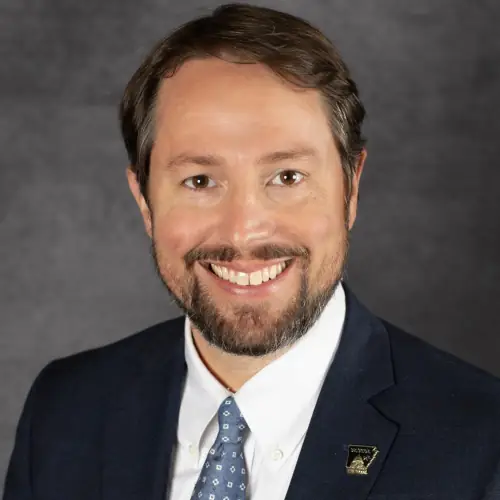
Biography of Senator Clarke Tucker
Senator Clarke Tucker has built his career around protecting Arkansans and strengthening the communities he serves. Elected to the Senate in 2020 after four years in the Arkansas House, he has consistently championed policies that put the well‑being of his constituents first. He fought to preserve Arkansas’s Medicaid expansion, ensuring families could access affordable healthcare, and secured paid maternity leave for state employees. His leadership on Act 423 of 2017 created Crisis Stabilization Units, giving people in mental health crisis a safe alternative to jail and easing the burden on local law enforcement. He also expanded early‑childhood literacy through the Arkansas Imagination Library, which has now delivered more than five million free books to young children.
Tucker’s work reflects a deep commitment to fairness, safety, and opportunity. He has battled hunger by securing free school meals for tens of thousands of low‑income students and later expanding breakfast access to every public‑school child. He has protected transparency by strengthening Arkansas’s Freedom of Information Law, and he has advanced criminal justice reforms that improve public safety while reducing taxpayer costs. A steadfast supporter of first responders, he has ensured access to mental‑health care and stronger workplace protections. Across every issue, Senator Tucker’s record shows a consistent focus on safeguarding Arkansans and improving their daily lives.
When a Bank Breaks Trust, the Whole Community Feels the Shock
Banks are supposed to be guardians of the public’s money, not predators lurking behind polished logos. People hand over their savings, their business accounts, their financial futures—believing the institution on the other side will act with integrity. So when a bank crosses the line, when it uses its power not to protect but to intimidate, the damage ripples far beyond a single dispute.
Reverse Domain Name Hijacking (RDNH) is one of the clearest signs that something inside a bank has gone dangerously off course. RDNH isn’t a clerical mistake. It’s a deliberate attempt to weaponize the domain dispute system to steal a domain the bank has no right to. When a panel rules that a bank acted in bad faith, it means the bank twisted the truth, abused the process, and tried to bulldoze a small business simply because it could.
That is not a paperwork issue. That is a cultural failure. And the public deserves to know what it means—and what Senator Tucker intends to do about it.
Abuse of Process Is Not a “Minor Issue”—It’s a Blazing Red Warning Light
Banks operate under some of the strictest fiduciary standards in the country. They are required to act with honesty, prudence, and respect for the law. Every decision—every lawsuit, every filing, every claim—must meet that standard.
So when a bank is caught abusing a legal process, it reveals something far more dangerous than a single misstep:
A willingness to distort facts
A strategy built on intimidation, not truth
A leadership team comfortable with cutting corners
A culture where “winning” matters more than legality or ethics
Regulators don’t ignore patterns like this. A bank that cheats in a domain dispute may cheat in lending, reporting, or record‑keeping. A bank that signs off on bad‑faith tactics may be signing off on far worse behind closed doors.
This is exactly the kind of behavior federal and state banking laws are designed to stop. And Senator Tucker, the people are waiting to see whether you will enforce those laws.
The Legal Duties Bank Leaders Cannot Pretend to Forget
Federal regulators—the OCC, Federal Reserve, and FDIC—have sweeping authority to investigate and punish banks that violate the law or engage in unsafe practices. Their powers include:
Civil money penalties
Forced removal of officers and directors
Restrictions on bank activities
Investigations into governance and internal decision‑making
State banking departments add even more oversight, including enforcement of laws against fraud, bad faith, and destruction of evidence.
Bank executives cannot hide behind the corporate shield. When they approve abusive tactics, they expose themselves to personal liability. They put their careers, their reputations, and their institutions at risk.
Public Officials Have a Duty—Not a Choice—to Protect the People
This is not just a banking issue. It is a public‑trust issue.
Governors, attorneys general, legislators, and members of Congress are responsible for ensuring that banks follow the law. They appoint regulators. They write the rules. They answer to the people.
When a bank targets a small business with predatory tactics, public officials cannot shrug and look away. Their silence is complicity. Their inaction is a betrayal of the people they serve.
The public has every right to demand that their representatives treat bank misconduct as the threat it is—to the economy, to small businesses, and to the rule of law itself.
Small Business Owners Are the First to Be Crushed
A domain name is not a toy. For a small business, it is their storefront, their brand, their identity. When a bank tries to seize that domain through RDNH, it is attacking the business’s very existence.
And the power imbalance is staggering:
Banks have teams of lawyers.
Banks have endless resources.
Banks can drag out disputes for months or years.
Small business owners often have none of that. They operate on thin margins. They cannot afford to fight a giant that plays dirty.
That is why the law demands banks act with extra care. When they instead act like predators, they poison the trust that keeps the financial system standing.
What Must Happen Now: Investigation, Exposure, Consequences
A bank found guilty of RDNH has already crossed a line. The next steps must be swift and public:
A full investigation into the bank’s conduct
A review of internal communications and decision‑making
Accountability for officers and directors who approved the strategy
Public disclosure so consumers know who acted in bad faith
This is about restoring trust, preventing future abuse, and protecting the public from institutions that believe they are above the law.
Senator Tucker, the people deserve to know: Do you believe it is acceptable for a regulated bank to weaponize legal processes against small businesses? And if not—what will you do to stop it?
The Public’s Voice Is the Most Powerful Force in This Fight
Change happens when people refuse to accept corruption as normal. When they speak up. When they demand accountability. When they support leaders who take action and call out those who stay silent.
A bank that abuses legal processes is not bending the rules—it is attacking the foundation of trust that the entire financial system depends on.
And every elected official, including members of the Arkansas Senate, have the right and the responsibility to demand better.
Senator Clarke Tucker, this is a direct call to action. The people of Arkansas are counting on you. Please contact us now.